


Heavy Duty Kitchen Grease Remover — No-Scrub Degreaser Spray
Heavy Duty Kitchen Grease Remover — No-Scrub Degreaser Spray
Couldn't load pickup availability
Shipping
Shipping
Fast shipping with tracking. Delivery in 5 to 7 business days. Free shipping over $50.
Money-back guarantee
Money-back guarantee
Spray it on one stain and watch. If it doesn't clean without scrubbing, return it within 30 days for a full refund.


That's not the finish wearing out. That's 30 years of cooking oil.
Every time you cook, oil aerosolizes and lands on everything within reach of the stove. Then it oxidizes and hardens into a sticky yellow-brown varnish that a wet cloth can't touch. This dissolves the bond so the layer lets go — no scrubbing, no sanding, no refinishing.

The line where you stopped wiping
One pass on the right, nothing on the left. Same door, same day. That edge is the whole product demo.

A filter you can see through again
Twelve years of buildup on one half, bare aluminium mesh on the other. Spray, wait, rinse.

It comes off ON the sponge
That brown isn't dirt from the sponge. That's what was living on your cabinet door.
The four places it's hiding right now
Three of these you look at every day and stopped seeing. The fourth you probably haven't taken down in years.
 The range hood filter
 Cabinet doors & handles
 Stove top & burners
 The wall & soffit above
Real lived-in kitchens, not staged ones. If your cabinets already look clean in the photo, the demo is worthless — so these aren't.
The baking soda and vinegar trick can't work. Here's why.
It's the most-shared kitchen hack on the internet, and it's chemically self-cancelling. Baking soda is a base. Vinegar is an acid. Put them together and they neutralize each other — the dramatic fizzing you're watching is the reaction using itself up.
base + acid → fizz → salt waterSo why does it seem to work at all? Because baking soda is gritty. You're not dissolving the grease — you're sanding it off. That's why it takes forty minutes a door, why it dulls a finish over time, and why it stalls completely on hardened buildup.
“The reaction you see after mixing lemon juice and baking soda is useless. Base and acid cancel each other. The reason why it works is because baking soda can also act as a scrub.” — a commenter who figured it out

Spray. Wait. Wipe.
Surfactants break the bond between the hardened oil and the surface. Once that bond is gone the layer has nothing holding it — so it comes away on the cloth instead of being scraped off.

Spray it on
Ready to use straight from the bottle. No dilution, no 10:1, no ratio to get wrong.
Give it a minute
This is the part people skip. Let it sit and do the work — you'll see the film start to slide.

Wipe it away
One pass with the included sponge. On heavy buildup, a second pass instead of forty minutes of scrubbing.

Strong enough for 20-year buildup. And you never have to leave the room.
The stuff that genuinely destroys baked-on grease usually says use outdoors on the can — and people follow that advice for a reason: burnt throats, stinging eyes, sending the family out of the house, then worrying about residue in the oven for days afterwards.
How it actually compares
| This degreaser | Baking soda + vinegar | Caustic oven cleaner | Boiling soak | |
|---|---|---|---|---|
| Dissolves hardened, oxidized grease | ✓ | ✗ You're sanding it | ✓ | ✓ |
| No scrubbing required | ✓ | ✗ That IS the method | ~ | ✓ |
| Safe to use indoors, no mask | ✓ | ✓ | ✗ “Use outdoors” | ✗ Fumes + burn risk |
| Works on vertical doors, walls, soffits | ✓ | ~ | ~ | ✗ Sink only |
| Ready to use, nothing to mix or dispose of | ✓ | ✗ | ~ | ✗ Greasy water |
The reaction is always the same

“I honestly thought that was just what the wood looked like. It came off on the sponge.”

“Hadn't taken the filter down in twelve years. I was expecting to buy a new one.”

“My hands hurt after ten minutes of scrubbing. This one I just wiped.”
What it won't do
You're being sold cleaning miracles constantly. Here's where this one actually stops.

You can. That's a fair point — here's the honest answer.
Per ounce, this loses to the dollar-store gallon and it isn't close. So don't buy it per ounce. The cheap gallon is mostly water, and the reason it's cheap is that the scrubbing is still your job. What you're paying for here is the part where you don't do that.
What buyers report


Spray one cabinet door tonight.
Do half. Leave the other half. If you can't see the line where you stopped wiping, we'll refund you — and keep the bottles, we're not asking anyone to ship back a used cleaner.
Frequently asked questions
Will it strip my cabinet finish?
This is the right question to ask, and the honest answer is: test first. It's formulated to break down grease rather than finishes, but a varnish that's already failing, a soft or chalky paint, or raw and oiled wood can react. Do the inside edge of one door, wait, and look. That thirty-second test is worth more than any reassurance we could write here.
Do I need gloves, a mask, or to open the windows?
No, and this is the point of it. It's designed to be used in the room where you cook, with your family in it — no caustic fumes, no burning eyes, no evacuating the kitchen and no residue anxiety before you next use the oven. Standard sense still applies: keep it out of your eyes, and off your skin if you have a known sensitivity.
My grease is much worse than in the photos. Will it still work?
Probably, but not in one wipe — and we'd rather say that up front. On heavy, hardened, decades-old buildup, expect to spray, wait longer, wipe, then repeat on the worst areas. It dissolves grease; where the layer has actually carbonized to black, that part needs the rough side of the sponge.
What surfaces can I use it on?
Range hood filters and hood exteriors, stove tops and burners, oven doors, backsplashes, painted walls and soffits, sealed cabinet doors, extractor housings, worktops and small appliances. Avoid raw/unsealed wood, damaged or flaking finishes, and anything already peeling. Rinse food-contact surfaces with clean water afterwards, as you would with any kitchen cleaner.
How much does one bottle cover, and what's in the box?
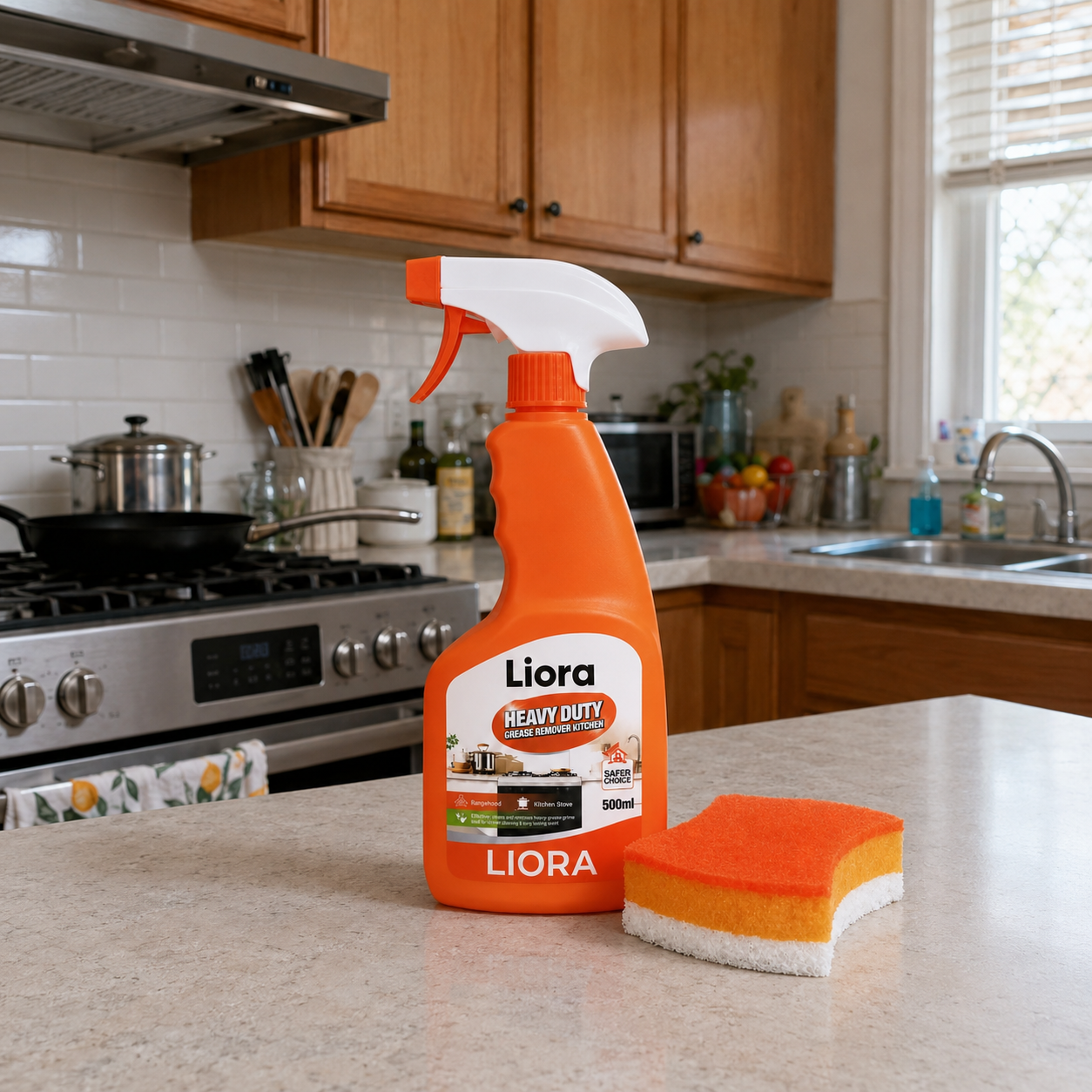
Each 500ml trigger bottle handles a full kitchen clean-down — hood, stove, cabinet fronts and the wall behind — with plenty left for upkeep. You get two bottles under the buy-one-get-one, plus the two-layer sponge (soft side for finished surfaces, scrub side for burners and filters).
Stop scrubbing. Start dissolving.
Heavy-duty on twenty years of hardened cooking grease — on hood filters, stove tops, cabinet doors, soffits and the wall behind the stove. Ready to use, nothing to mix, no greasy water to get rid of, and no reason to leave the room while it works. Two 500ml bottles and the sponge for $29.99, with 30 days to change your mind.
Heavy duty kitchen degreaser for range hood filters and housings, stove tops, burners, oven doors, backsplashes, painted walls and soffits, sealed cabinetry and small appliances. It dissolves grease and oil films; heavily carbonized deposits may require a second application and mechanical agitation. Always test on a small hidden area first — degreasers can affect failing varnish, soft paint, and raw or oiled wood. Not for use on unsealed wood or flaking finishes. Rinse food-contact surfaces with clean water after use. Avoid contact with eyes; wash hands after prolonged contact. Keep out of reach of children and pets. Results vary with the age, thickness and type of buildup.