


Advanced Fuel System Cleaner
Advanced Fuel System Cleaner
Couldn't load pickup availability
Shipping
Shipping
Fast shipping with tracking. Delivery in 5 to 7 business days. Free shipping over $50.
Money-back guarantee
Money-back guarantee
Run one full tank and judge it yourself. If your engine doesn't run smoother, return it within 30 days for a full refund — a real PEA formula, not the snake oil you've been burned by before.


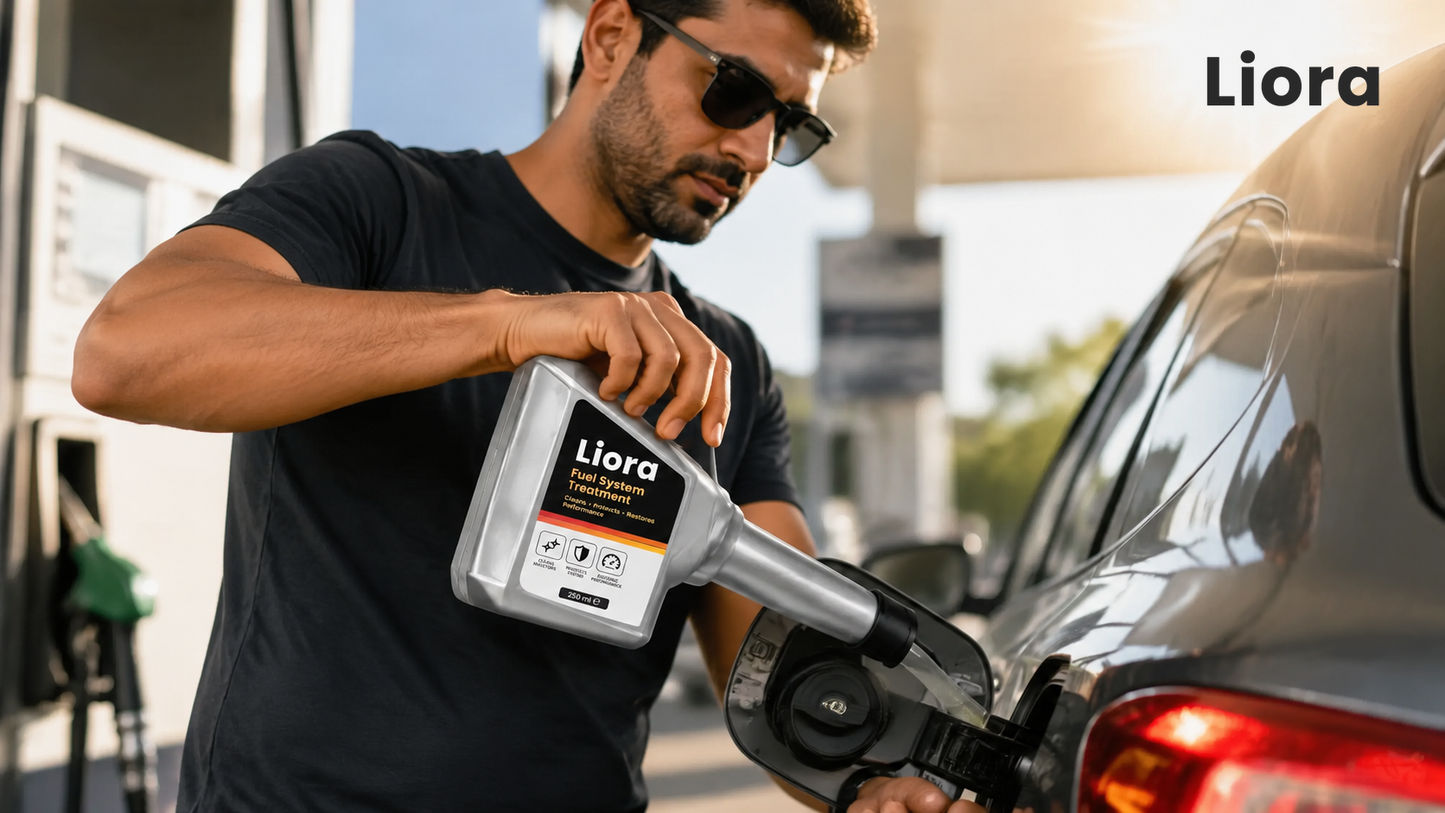
Not another snake-oil bottle — the one built on PEA.
Most cheap fuel cleaners are colored solvent with no muscle for baked-on carbon. Liora is built on PEA (polyetheramine) — the detergent that actually cleans injectors and brings your engine back.

PEA That Actually Works
Polyetheramine survives combustion heat to dissolve baked-on carbon and unclog injectors — the job weak solvents can't do.

More Miles Per Gallon
A clean, optimized engine burns fuel efficiently. Drivers report real MPG gains — one from 14.1 to 20.1 mpg.

Protects & Passes Emissions
Leaves a protective barrier, helps lower emissions and protect the catalytic converter — ready for inspection.

The secret is PEA — not colored solvent.
Ever open a cheap bottle and it smells like kerosene? That's colored solvent with no muscle for heavy carbon — it won't touch a clogged injector. Liora is built on PEA (polyetheramine), the detergent that survives combustion heat, breaks down hardened deposits and rebuilds the injector spray pattern.
What it clears inside your engine
Years of driving cake your injectors, EGR valve, intake valves and pistons with carbon — choking power and MPG. Here's the before & after a PEA deep-clean.
 BEFORE
 AFTER
AFTER BEFORE
 AFTER
AFTER BEFORE
 AFTER
AFTER BEFORE
 AFTER
AFTERIllustrative of the kind of carbon buildup a PEA fuel-system cleaner targets. Actual results vary with engine condition and level of deposits.
Everything a real fuel cleaner should be
The right chemistry, dead-simple to use — a whole injection service in your cupholder.
PEA Detergent
The active ingredient that dissolves baked-on carbon and unclogs injectors — not weak solvent.
Restores Power
Smooths rough idle, fixes long cranks and hesitation, and brings back lost acceleration.
Better MPG
A clean engine burns fuel efficiently — stop wasting money at the pump.
Protects The System
Leaves a lubricating barrier that slows new buildup and helps protect the catalytic converter.
Deep clean in four simple steps
No tools, no shop, no $300 induction service. Pour, drive, and feel the difference — usually by the first or second tank.
Empty the bottle into your fuel tank just before refueling so it mixes with the gasoline.
Just drive normally. The PEA circulates through the system, dissolving carbon and cleaning injectors.
On a neglected engine you may briefly see black smoke — that's carbon being expelled. It's normal and clears.
Feel it by the first or second tank. Repeat every ~3,000 miles or at each oil change — not every tank.
Why they stopped paying the shop

“Next day the long cranking was gone and it's running smoother. Real MPG jump by the second tank.”

“Had a smog test coming up and a check-engine light. Poured it in, drove — light stayed off, passed emissions.”

“Yeah there was black smoke the first drive — that's the carbon. After that it pulls stronger and idles smooth.”
How it compares to the alternatives
| Liora (PEA) | Cheap Solvent Bottle | Good Gas Alone | Shop Induction Service | |
|---|---|---|---|---|
| Removes baked-on carbon deposits | ✓ | ✗ | ✗ | ✓ |
| Restores the injector spray pattern | ✓ | ✗ | ✗ | ✓ |
| Cleans modern GDI direct-injection carbon | ✓ | ~ | ✗ | ✓ |
| Do-it-yourself, no shop visit | ✓ | ✓ | ✓ | ✗ |
| Cost | $ Bottle | $ Cheap | $$ Ongoing | $$$ ~$300 |
From the pump to a cleaner engine


What drivers are saying


Judge it by one full tank.
Skeptical? Fair — most cheap additives ARE junk. So try it risk-free. Run one full tank as directed and feel the difference for yourself: smoother idle, easier starts, better mileage.
Frequently asked questions
Does this actually work, or is it snake oil?
Fair question — most cheap additives ARE weak colored solvent. The difference here is PEA (polyetheramine), the detergent that survives combustion heat and breaks down baked-on carbon to restore the injector spray pattern. That's what cleans injectors and brings back power, smooth idle and MPG. Judge it by the ingredient and the results: smoother idle, easier starts and real mileage gains, usually by the first or second tank.
How is it different from a cheap bottle or just good gas?
Cheap PIBA/kerosene-type bottles and pump gas keep things from getting worse but won't remove years of baked-on deposits. A true PEA formula actually dissolves that hardened carbon and rebuilds the spray pattern — the job weak solvents and Top-Tier gas alone can't do.
Will it hurt my engine or catalytic converter?
No — a real PEA formula is safe for your fuel system and cat. It's the junk, off-brand cleaners that can dislodge debris into the catalytic converter. Used as directed, Liora cleans and protects; it even leaves a barrier that slows new buildup and helps lower emissions.
There's black smoke on the first use — is that bad?
No, that's a good sign. On a neglected engine the black smoke is baked-on carbon being expelled during the first cleaning. It's normal and clears on its own as the system cleans out.
How often should I use it, and will it fix my rough running?
Pour one bottle in the tank before a fill-up and drive normally; repeat every ~3,000 miles or at each oil change — you don't need it in every tank. It cleans deposits and keeps injectors healthy, so it fixes carbon-related rough idle, hesitation and hard starts. It won't fix a mechanical fault (bad fuel pump, coil) or an injector that's already fully dead.
Give your engine a second life — for the price of a bottle.
A PEA-based fuel system treatment that dissolves baked-on carbon, unclogs injectors and restores the spray pattern — bringing back lost power, a smooth idle and better MPG, and helping you pass emissions. Just pour it in the tank before you fill up and drive. Backed by a 30-day money-back guarantee and fast, tracked shipping.
PEA-based gasoline fuel-system treatment for cleaning fuel injectors and removing carbon deposits. It cleans deposits and helps keep injectors healthy; it will not repair a mechanical fault (fuel pump, coil) or an injector that is already fully failed. Brief black exhaust smoke on first use on a neglected engine is carbon being expelled and clears on its own. Use as directed: add to the fuel tank before refueling, drive normally, repeat every ~3,000 miles / 5,000 km. Not for use in diesel engines. Not affiliated with or endorsed by any other brand mentioned by customers. Individual results vary; MPG and performance figures reflect individual experiences. Keep out of reach of children.